



Starting frame:
High-quality image
August 2026
An innovative collaboration is bringing custom artificial intelligence (AI)-generated videos to UHealth spaces, designed to create calmer environments for patients and families while eliminating thousands of dollars in annual licensing costs.
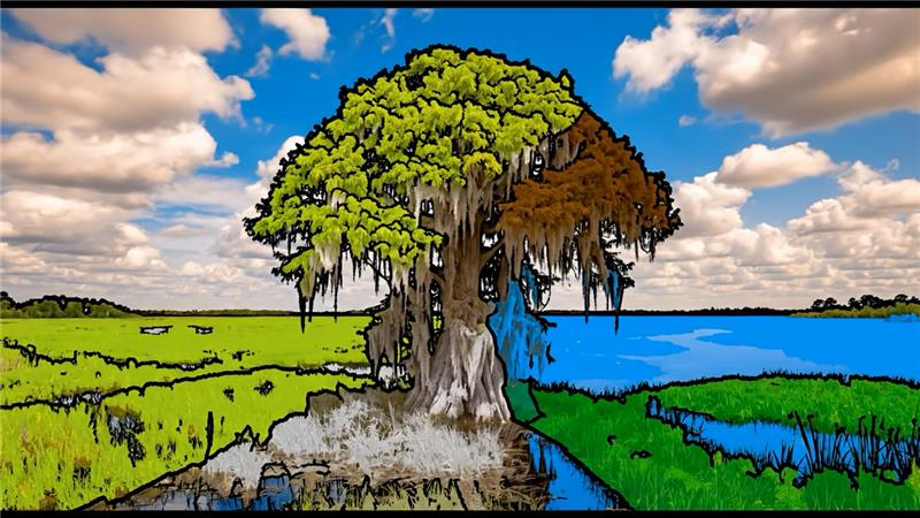
The Art of Calm video art being played on the ultra-wide theater-sized screen at UHealth Doral. Walk past the lobby video wall at UHealth Doral Medical Center and you might catch a wave rolling in slow motion across a stretch of pale sand. Walk past the one at UHealth SoLé Mia Medical Center and it could just as easily be morning light drifting over the Everglades, or a mountain stream easing into a still, glassy lake. None of it repeats in any way you would notice. There is no music, no ticker, no cable news, just light and time—moving at the pace of a very deep breath. You might wonder how someone captured such breathtaking footage. The answer is, they didn't. Every scene is AI-generated as part of "The Art of Calm" initiative, UHealth's new custom digital video experience at its newest clinical facilities. Each video was built around what a specific location actually asked for, not pulled from a generic template. Together, they replaced a licensed video contract that had quietly cost the health system thousands of dollars a year. Experience some of our favorite scenes from The Art of Calm video library at UHealth Doral Medical Center. On paper, the concept seemed straightforward: take the video walls that had been running licensed stock footage on a recurring contract, and replace them with content generated in-house using AI, so the health system keeps full ownership of the content, can tailor it to each location, and stops paying an outside vendor year after year. The clinical case was just as important as the financial one. Hospitals can be stressful environments for patients and families, particularly during periods of waiting and uncertainty. The idea behind "The Art of Calm" was to give those spaces something calmer to look at: slow, predictable, non-narrative motion instead of a static image. A small group, part of University of Miami Information Technology & Systems (ITS) AI team, set out to build a library of ambient videos, each with its own nature-inspired visual theme, like beach waves, underwater scenes, and the Everglades—produced for both the Doral and SoLé Mia displays. None of the videos was a copy-paste of another, and each theme was chosen and shaped around what that specific location stakeholders were looking for, from the mood they wanted to the pace and color palette that fit the space. Every clip, whatever the scene, was generated by Veo 3.1, an AI video model, and stitched from 8-second segments into a seamless, silent, infinitely repeating loop. The breakthrough isn't that AI can generate video, it's that the cost of creating studio-quality content has fallen dramatically. "What people don't see is the work between the prompt and the final result. These models are getting better every month, but producing something that is seamless, reliable, and ready for a real-world environment still takes far more than pressing a button," said Dr. David Wayne, Chief Artificial Intelligence Officer. An example of a photo-realistic AI-generated video. The AI team's first assumption was that generating a calming ambient scene would be the easy part, and the real work would be the deployment. It turned out to be almost exactly backwards. Creating an eight-second AI-generated video was one thing. Turning a series of those clips into a seamless experience that could play continuously for more than ten minutes was something else entirely. Early tests revealed inconsistencies that became more noticeable as clips were extended; a limitation grounded in video generation models. A camera that should have moved at a slow, steady pace could suddenly speed up or change direction from one segment to the next. Water, clouds and other elements did not always move naturally, and visual quality could begin to deteriorate after several consecutive generations, in some cases after just 24 to 32 seconds. The team also encountered issues with video artifacts, including a phenomenon called "ghosting." During testing, moving objects could disappear, change shape, or look different from one clip to the next. Motion blur could compound the problem when a frame from one clip was used as the starting point for the next. Brightness and color presented another challenge, sometimes shifting noticeably between clips. For a traditional video, some of those differences might go unnoticed. For "The Art of Calm," they mattered. The goal was to create slow, continuous motion that blended naturally into the environment. A sudden change in speed, direction, image quality or brightness could break that sense of continuity. And any minor flaw gets amplified when displayed on a large screen. Addressing those issues required a combination of iterative experimentation. The team tested different approaches to controlling camera movement, such as seeding the video generation with carefully curated start and end frames and slowing down videos based on measured motion speed between clips with custom computational methods. Clips that did not meet the desired quality were regenerated, while subtle transitions helped minimize visible changes in brightness between segments. There was no single solution that worked for every scene. A technique that improved one video did not necessarily work for another, and some challenges could only be addressed through repeated generation and manual review. Over time, that experimentation gave the team a more reliable process for determining which approaches worked best for different types of scenes. The displays themselves added another layer of complexity. Veo3.1 natively outputs video in a 16:9 format. The screen at Doral is ultra-widescreen at 30:9, and SoLé Mia is closer to 5:4. Creating prompts to instruct the model to output in those aspects ratios was unreliable, so we had to use other techniques such as feeding it an image in the correct aspect ratio as the first frame of the video. Moreover, with each facility having different screen formats, we had to ensure the same visual concept worked in two different aspect ratios. The team explored whether one version could simply be cropped or reformatted for the second display, but the resulting loss in quality was too noticeable. Instead, the videos had to be generated separately for each format—effectively creating two productions for every scene.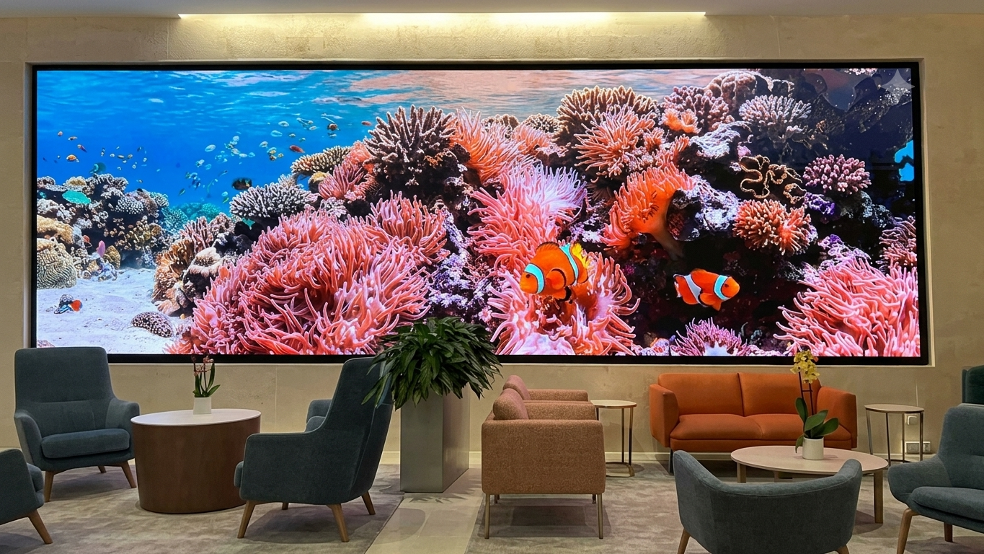
A Simple Idea, A Complicated Build

When "Simple" Wasn't So Simple
Starting frame:
High-quality image
Ending frame:
Extending the video results in Ghosting
The technical challenges were only part of the process. Defining what a successful experience should look and feel like required close collaboration with stakeholders at each location. "The Art of Calm" initiative had two groups of requesting stakeholders, one for each building, and each had their own sense of the right mood, the right pace, the right scene. Early on, that meant a lot of back-and-forth: a video would come back from generation looking, to the team, like exactly what was asked for, and then go through another round of refinement as the request was clarified further. The challenge reflected how difficult it can be to translate a subjective feeling like "calm" into a precise visual brief. The team estimates that each successful clip typically required about five rounds of generation and refinement before reaching the desired result. Each attempt taught the team something about what worked and what didn't, but it meant the real production process looked less like "type a prompt, get a video" and much more like a long, iterative back-and-forth: generate, review, refine, and try again. By the later videos, that loop got noticeably faster, once the team and the stakeholders had built a shared vocabulary for what they were actually asking for. "We generate a lot more video than what ultimately gets shown," said Trevor Yuen, Executive Director of IT Data Science & Engineering. "Even now, for maintenance and new scenes going forward, that's probably still going to be the rate." An example of temporal inconsistency in AI-generated video: Follow the sea turtle! The impact of that iterative work is measurable. The licensed video contract previously used across the two buildings incurred significant recurring annual costs for UHealth. By bringing the work in-house, UHealth replaced that recurring expense with a one-time investment, a fraction of the prior annual cost, in AI tooling and internal staff time to develop "The Art of Calm" video library and establish the production process. With that recurring annual licensing expense eliminated, the initial investment is expected to pay for itself within the first year while significantly reducing ongoing content costs. The value extends beyond cost savings. UHealth now owns the content and has developed an internal capability to create and customize new scenes based on the needs of individual locations. Rather than relying on a library of licensed content, teams can tailor the visual environment to a specific space, audience, mood, or display format. The team estimates that, with the process and technical framework now established, a new video or refresh of an existing one now comes at a modest, predictable cost. That benchmark gives UHealth a repeatable model for evaluating future projects against outside vendor costs while continuing to expand a library of content designed specifically for the UHealth environment. The Art of Calm video art being played on the 32ft x 26ft screen at UHealth SoLé Mia. Numbers tell part of the story. The rest of it is in the hallways and waiting rooms where these videos actually play.
Defining What "Calm" Looks Like

The Impact

What Patients and Staff Are Saying
"The beach scenes are beautiful. For a moment, you almost forget you’re at a medical appointment. It creates such a peaceful atmosphere and really helps you feel more relaxed while you wait."
- UHealth Doral Patient
"I love seeing the beach scenes throughout the day. They bring a sense of calm and positivity to the space, not only for our patients and families, but for those of us who work here too."
- UHealth Doral Employee
"It took time, collaboration, and patience to achieve the vision we had in mind, but through their dedication and commitment, the AI team was able to create the imagery and aesthetic we were seeking. The resulting scenes beautifully capture the feelings we hoped to evoke for everyone entering our building: warmth, joy, hope, and peace. They helped us transform our vision into something that can be experienced and enjoyed by our patients, families, visitors, staff, and providers each day."
- DeDe C. Austin,
Assistant Vice President, Ambulatory Services
"Our digital art wall was thoughtfully curated to promote healing and recovery for our patients while also providing comfort and support to their caregivers during what can often be a stressful time. It creates a meaningful and welcoming environment, making a remarkable first impression and leaving a lasting impact. We greatly appreciate the team's efforts and continued collaboration in bringing art to life through technology and AI."
- Vandana Pathak,
Assistant Vice President, Ambulatory Services
With "The Art of Calm" library now established, the team has created more than a collection of videos—it has built a repeatable process that can be adapted to new scenes, locations, and environments across the University of Miami. What began as an effort to replace licensed content has evolved into an internal capability to create customized digital experiences that can be owned, adapted, and expanded over time, demonstrating how AI can address a specific need while delivering measurable value. As the initiative grows, however, the technology itself is meant to fade into the background, leaving behind what mattered from the beginning: moments of beauty and calm that make University of Miami spaces more welcoming for everyone. Experience some of our favorite scenes from The Art of Calm video library at UHealth SoLé Mia Medical Center.
What's Next
